Romania’s Court of Accounts has officially confirmed one of the country’s most glaring cases of EU funds fraud: illegal waste management contracts, a fabricated public emergency, and approximately €30 million in European structural funds at serious risk of repayment — all at a single facility in Roești, Vâlcea County.
The findings, published in Audit Report No. 278 on March 19, 2026, validate what investigative outlet Ziarul de Investigații – zin.ro documented from the field nine months earlier.
Total fine imposed for three confirmed violations of Romanian and EU procurement law: €1,500.
Romania EU Funds Fraud: The Facility That Never Worked
The Roești Integrated Waste Management Center (CMID Roești) was financed with over €26 million in EU structural funds under Romania’s Large Infrastructure Operational Programme 2014-2020 (POIM).
It was designed to sort, treat and safely dispose of waste from across Vâlcea County. It was inaugurated in January 2024.
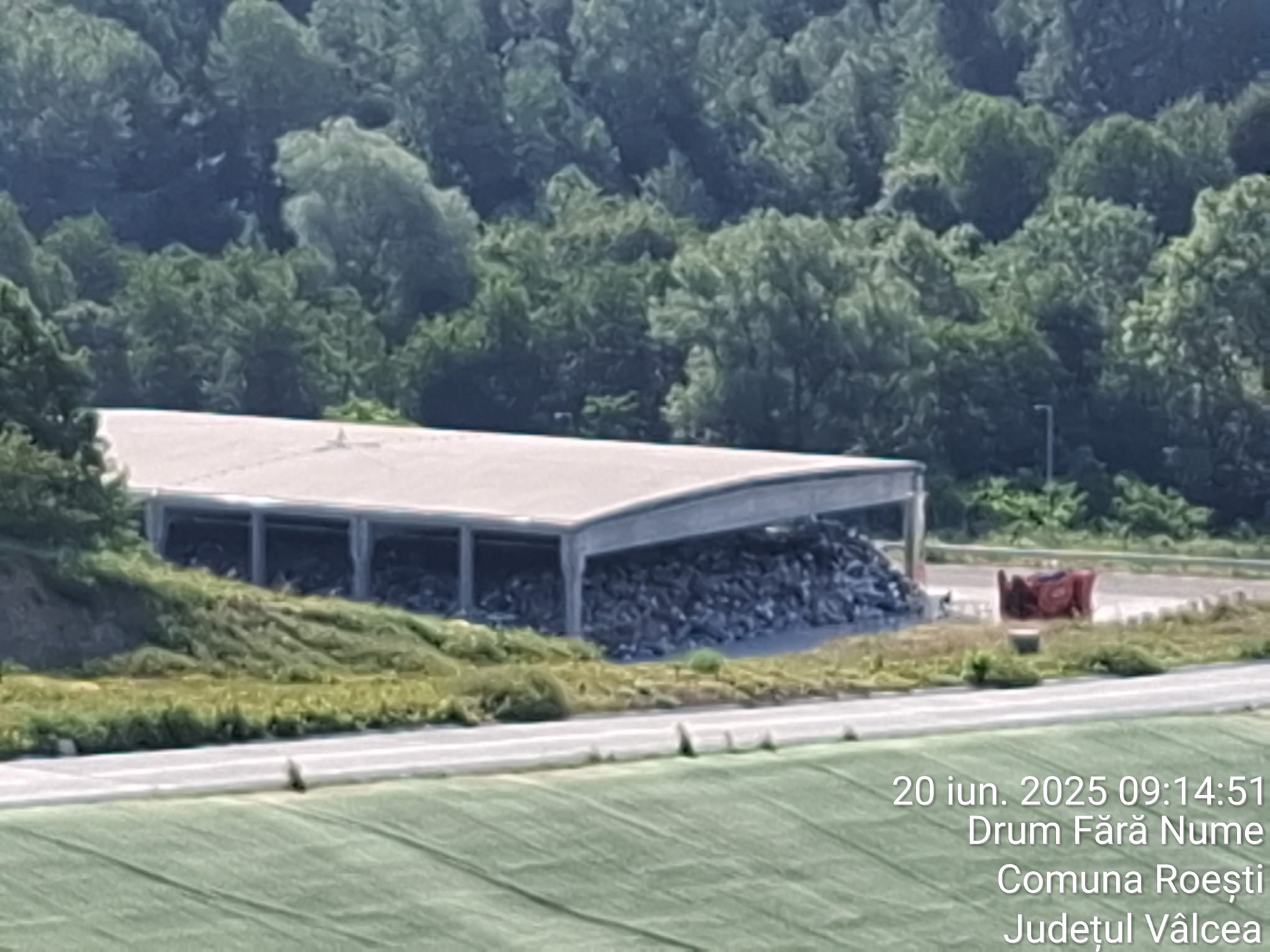
By June 2025, field reporting by Ziarul de Investigații – zin.ro revealed the reality: tonnes of unsorted household waste dumped directly onto open platforms, no sorting activity, no waste treatment, no environmental protection. The facility was operating as an open landfill — in direct violation of EU environmental standards and the terms of its European financing agreement.
A follow-up visit one month later confirmed the situation had deteriorated further. No remediation had begun. No enforcement authority had intervened.
How EU Procurement Rules Were Bypassed in Romania
In early 2025, ADI Salubrizare Vâlcea — the intercommunity association responsible for waste management across Vâlcea County — awarded two concession contracts for the operation of the Roești facility and the county’s wider waste collection network.
No open tender was held.
Instead, the contracts were awarded through direct negotiation, using a fabricated sanitary emergency as legal cover. The Vâlcea County Emergency Committee adopted Resolution No. 16 on October 11, 2024, declaring an emergency in waste management. This resolution was then invoked — alongside a 2019 Government Memorandum — to bypass the EU public procurement rules that Romania is legally bound to follow.
The contracts went to an association between Brantner Environment SRL, an Austrian-owned waste company, and Environment Care Waste Management SRL — a company with ten employees, an annual turnover of approximately €200,000, and links to controversial figures in Romania’s waste management industry.
Court of Accounts Audit: Three Violations of EU and Romanian Law
Romania’s Court of Accounts opened its compliance audit at ADI Salubrizare Vâlcea on September 15, 2025. The audit covered January 1, 2024 to August 31, 2025.
Report No. 278, approved March 19, 2026, confirmed three distinct legal violations.
Violation 1: A Final Court Ruling Was Ignored
Romania’s National Council for Solving Contestations (CNSC) had issued a binding decision requiring ADI to correct its procurement documentation for the Roești contract. The Pitești Court of Appeal upheld the decision, making it final and enforceable.
ADI did not comply.
The reason given to auditors: the consultant who prepared the documentation „was no longer responding to requests.”
This constitutes a violation of Article 111(2)(d) of Law No. 100/2016 on service concessions — the Romanian law implementing EU Directive 2014/23/EU on the award of concession contracts.
Violation 2: A Procurement Procedure Was Cancelled on False Grounds
On January 20, 2025, ADI cancelled the open tender for the Roești contract, citing a court ruling as justification. The Court of Accounts found the justification to be legally incorrect: the ruling required documentation to be corrected, not the procedure to be cancelled.
The cancellation violated Article 111(2)(k) of Law No. 100/2016.
Violation 3: Direct Award Through a Fabricated Emergency
This is the most serious finding — and the most relevant for EU institutions.
ADI used the fabricated October 2024 emergency declaration to initiate two negotiated procedures without prior publication, circumventing competitive tendering entirely. The Court of Accounts identified a dual illegality: ADI used concession contract documentation to award contracts formally classified as public procurement contracts — two legally incompatible instruments under Romanian and EU law.
Provisions violated:
- Article 5 and Article 154(1) of Law No. 98/2016 — Romania’s public procurement law, implementing EU Directive 2014/24/EU
- Article 30(1) and (5) of Law No. 51/2006 on community utility services
At the time of the audit, three lawsuits seeking annulment of the two contracts were pending before Romanian courts — two at the Bucharest Tribunal, one at the Vâlcea Tribunal.
Criminal Liability: What the Court of Accounts Left Unanswered
The confirmed violations raise questions that extend beyond administrative sanctions under Romanian and EU procurement law.
Under Romanian criminal legislation, the following provisions are directly relevant:
Ignoring a final court ruling — Article 287 of the Criminal Code, punishable by 3 months to 2 years imprisonment or a criminal fine.
Awarding public contracts in violation of procurement law, causing harm to public or EU funds — Article 297 of the Criminal Code — abuse of office, punishable by 2 to 7 years imprisonment. When European funds are involved, Article 132 of Law No. 78/2000 on preventing corruption provides an aggravated form carrying 3 to 10 years imprisonment.
Use of EU funds contrary to their designated purpose — Article 18¹ of Law No. 78/2000, punishable by 2 to 7 years imprisonment.
The October 2024 Emergency Committee resolution, if it recorded a non-existent emergency to justify bypassing EU procurement rules — Article 322 of the Criminal Code — forgery of official documents, punishable by 1 to 5 years imprisonment.
The Court of Accounts did not refer the matter to prosecutors. Report No. 278/2026 addressed the violations exclusively at the level of administrative contraventions. The criminal analysis above reflects an assessment of confirmed facts against applicable Romanian legislation. Establishing criminal liability is the exclusive competence of judicial authorities.
€30 Million at Risk: The EU Funds Repayment Threat
The financial stakes are significant for both Romania and the European Union.
Each of the three confirmed violations carried a maximum fine of 30,000 Romanian lei. ADI Salubrizare Vâlcea paid the statutory minimum: 2,500 lei per violation — half the minimum penalty, available under Article 28(1) of Government Ordinance No. 2/2001 for payment within 15 days.
Total paid: 7,500 lei — approximately €1,500.
Total EU investment at risk: approximately €30 million.
The Court of Accounts report explicitly identifies a critical deadline: Romania’s Ministry of Investments and European Projects (MIPE) has imposed December 31, 2026 as the final date for closing the SMID Vâlcea project. If competitive procurement procedures are not completed and valid contracts awarded before that date, Romania faces the obligation to repay EU structural funds already disbursed for the project.
As of the audit date, the revised procurement documentation had not yet been approved by ADI’s General Assembly — a mandatory prerequisite before any new competitive procedure can be launched.
A Pattern of Institutional Failure
The timeline reveals a consistent pattern of institutional failure at multiple levels.
In June 2025, Romania’s Vâlcea Environmental Protection Agency (APM Vâlcea) issued a 60-day suspension of the operator’s environmental permit — then annulled its own decision the same day, citing a procedural error in its own process.
The head of APM Vâlcea acknowledged in a phone call that the situation at Roești was „toxic, abnormal and extremely dangerous.” No effective enforcement followed.
Romania’s Ministry of Environment took no concrete action. No inspection was dispatched. No emergency evaluation was ordered.
On January 26, 2026 — while Court of Accounts auditors were still on site — ADI’s president signed addenda to both contested contracts, eliminating clauses that had allowed for their extension. The timing raises legitimate questions about the intent behind the move.
ADI Salubrizare Vâlcea did not contest any finding during the February 9, 2026 conciliation session.
What This Means for EU Institutions
This case presents several elements of direct relevance to European Union oversight bodies.
EU structural funds were disbursed for a facility that has not operated in accordance with the terms of its financing agreement, EU environmental directives, or EU public procurement rules.
The contracts awarded to operate that facility were found by Romania’s own audit authority to violate Romanian laws implementing EU Directive 2014/23/EU and EU Directive 2014/24/EU.
A fabricated emergency was used as the mechanism to bypass competitive tendering — a practice that, if left unsanctioned at the criminal level, sets a replicable precedent for the misuse of EU funds across Romania’s infrastructure projects.
The administrative fine imposed represents less than 0.005% of the EU funds at risk.
OLAF — the European Anti-Fraud Office — has jurisdiction to investigate suspected fraud affecting the EU’s financial interests. The confirmed facts in this case fall within that mandate.
Confirmed Facts, Unanswered Questions
Romania’s Court of Accounts has established, through formal audit procedure, that EU procurement rules were violated, that a final court ruling was ignored, and that approximately €30 million in European structural funds are at risk of repayment.
Ziarul de Investigații – zin.ro reported the same facts from the field in June and July 2025 — nine months before the official audit confirmation.
The December 31, 2026 deadline is eight months away. Three court cases are pending. No criminal referral has been made. The operators remain in place.
The question is no longer whether EU funds fraud occurred at Roești Vâlcea. The question is who will be held accountable — and whether €30 million of European taxpayers’ money will be recovered before the answer comes.